


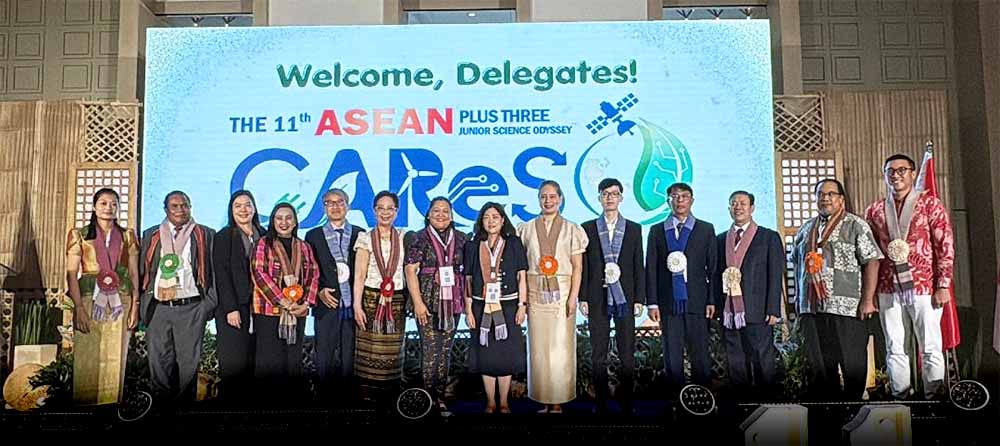
CLARK FREEPORT ZONE (PIA) — The Philippines welcomed young science talents from across the Association of Southeast Asian Nations (ASEAN) and its dialogue partners as it officially opened the 11th ASEAN Plus Three Junior Science Odyssey (APTJSO-11), reinforcing regional cooperation in addressing climate change through science and innovation.
Hosted by the Department of Science and Technology (DOST) Philippine Science High School System in partnership with the ASEAN Secretariat and the ASEAN Plus Three Center for the Gifted in Science, the weeklong activity gathered in Clark Freeport Zone gifted students aged 13 to 15 from the 11 ASEAN member-states and the Republic of Korea.
Carrying the theme “Climate Action and Responsible e-nnovation for Sustainability,” the Odyssey aims to deepen scientific knowledge while fostering cross-cultural collaboration and developing practical solutions to climate and sustainability challenges.
DOST Undersecretary for Scientific and Technical Services Maridon Sahagun said the gathering reflects the region’s shared commitment to prepare young scientists who will help shape a more sustainable future.
“This year’s theme is more than a slogan. It is a regional call to action. It reflects our shared commitment to empower the youth—our young scientists—to become innovators, collaborators, and leaders who will help build a more sustainable and disaster-resilient ASEAN,” she said.
Deputy Secretary-General for the ASEAN Economic Community Satvinder Singh emphasized that science has become central to economic growth, resilience, and regional development.
“Science is currently shaping how nations compete, how our economies grow, how our societies respond to crises, and ultimately how our collective future can be defined,” he said.
For Philippine Science High School System Executive Director Ronnalee Orteza, the Odyssey offers more than scientific learning.
“The ASEAN Plus Three Junior Science Odyssey is much more than an academic event. It is where curiosity meets opportunity, where talent meets purpose, and where the future scientists, engineers, innovators, and leaders of our region begin building the relationships that will shape tomorrow,” she said.
Throughout the week, delegates will participate in scientific lectures, laboratory work, field investigations, innovation challenges, and cultural exchanges designed to strengthen scientific excellence and regional cooperation.
By hosting APTJSO-11, the Philippines underscores its commitment to advancing science diplomacy and empowering young innovators to contribute to climate action and sustainable development across ASEAN. (Marie Joy S. Carbungco )