


CITY OF MALOLOS — San Miguel Aerocity Inc. (SMAI), developer of the New Manila International Airport (NMIA) in Bulakan, Bulacan, said the project was designed with long-term flood mitigation measures and did not cause the province’s recent flooding.
SMAI said extensive hydrological studies and modeling by Danish firm DHI began in 2018, examining river flows, coastal waters, storm surges, land subsidence, and the possible effects of airport development on surrounding communities.
“NMIA did not cause Bulacan’s flooding. This is a problem the province has had to contend with for many generations. Our responsibility is to make sure the airport is built for these conditions, and that its development does not make flooding in the province worse,” the company said.
Flooding in Bulacan predates NMIA by many, many decades, and is driven by a combination of the province’s low-lying geography, heavy rainfall and river flows from upstream areas, limited river capacities, and land subsidence. In addition, rising sea levels and continued development across the province, are adding pressure to an already complex watershed.
A 2019 flood assessment recommended engineered improvements to river capacity. In 2021, Mott MacDonald consolidated the studies and considered long-term land subsidence and climate projections up to 2100, resulting in plans to raise the airport platform to between 3.85 and 5.50 meters above mean sea level.
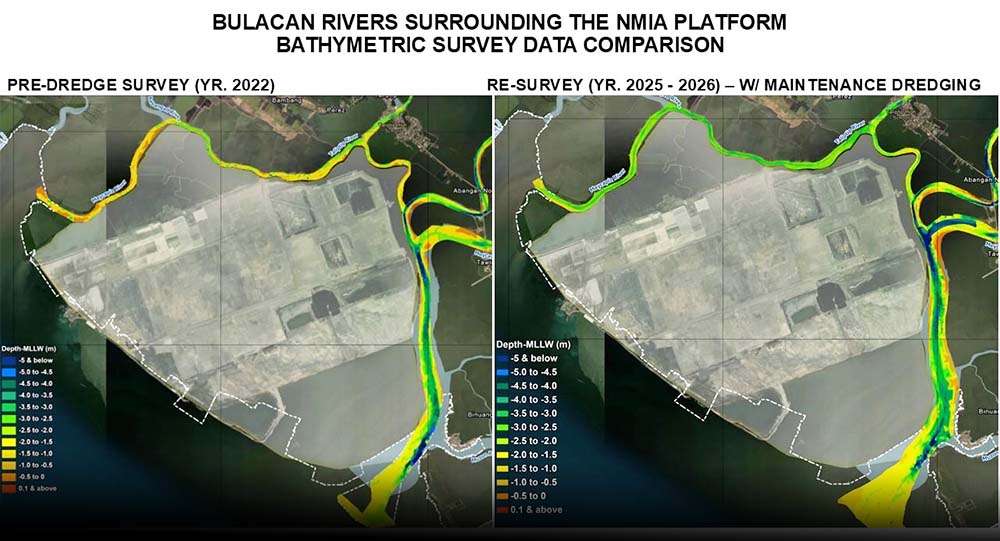
Instead of extensive river widening, SMAI said riverbed deepening was adopted for the Maycapiz-Taliptip, Santa Maria, and Meycauayan rivers. From 2022 to 2024, San Miguel Corporation removed more than 1 million metric tons of silt and waste from the three rivers. Its wider Bulacan river cleanup program has since removed more than 4.3 million metric tons.
SMAI also clarified that NMIA is a land-development project on existing titled land formerly used as fishponds, not a reclamation project.
The company stressed that Bulacan’s flooding is a much broader watershed problem caused by low-lying geography, heavy rainfall, upstream runoff, limited river capacity, land subsidence, high tides, and rising sea levels.
SMAI said protecting NMIA and addressing Bulacan’s province-wide flooding are separate but interconnected challenges requiring continued dredging, stronger river infrastructure, floodgates, and pumping systems in vulnerable coastal areas. (UnliNews Online)

