


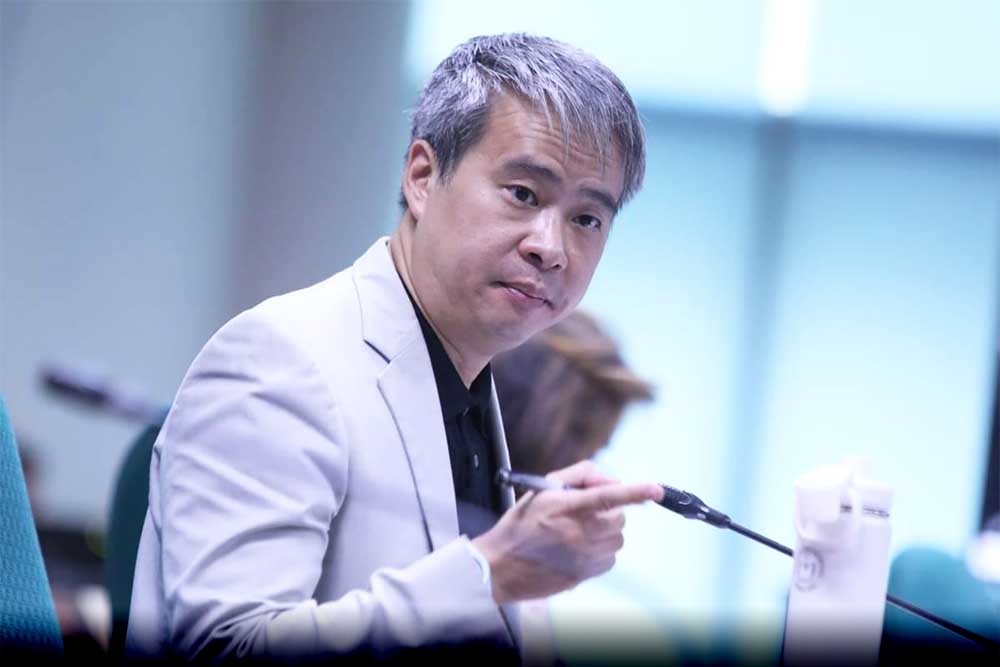
SENATOR Joel Villanueva urged the Development Budget Coordination Committee (DBCC) to lay out a clear, time-bound plan for putting the country’s debt burden on a sustained downward path, warning that budget after budget, the government’s debt continues to rise.
During budget deliberations, Villanueva noted that national debt has climbed to P19.07 trillion, equivalent to 66 percent of gross domestic product as of June 2026. He asked DBCC officials what primary balance is needed to put the debt-to-GDP ratio on a firmly declining path, and when the country could realistically expect to see it happen.
National Treasurer Sharon Almanza responded that, based on DBCC’s debt sustainability analysis, the debt-stabilizing primary balance is a deficit equivalent to 0.9 percent of GDP.
Villanueva then pressed the DBCC to explain when the government expects to reach that benchmark and move beyond stabilization toward a sustained reduction in the debt-to-GDP ratio. The DBCC currently projects the overall fiscal deficit at around 5.45 percent of GDP in 2026, 5.1 percent in 2027, 4.8 percent in 2028, 4.2 percent in 2029, and 3.5 percent by 2030.
“We got an answer, but not a complete one,” Villanueva said. “The real question is timeline: when do we actually see and accomplish this declining path? We need to know when the government expects to reach the primary balance needed to stabilize the debt, and when we can expect the debt burden to meaningfully go down.”
Villanueva also asked how sensitive that trajectory is to slower GDP growth, higher interest rates, or a weaker peso, risks he said could push the target even further out of reach.
The senator likewise expressed concern over the recent weakening of the peso, as the exchange rate reached the P62-to-US dollar mark. Villanueva said the development warrants close attention given its potential impact on inflation, debt servicing costs, and the government’s already limited fiscal space. A weaker peso, he noted, could further increase the cost of servicing foreign-denominated obligations and add pressure to government finances.
The exchange comes as Congress begins deliberations on the proposed P7.2-trillion National Expenditure Program for 2027, equivalent to 21.7 percent of gross domestic product and 6 percent, or P407 billion, higher than the P6.793-trillion national budget enacted for 2026.
In its own budget memorandum, the Department of Budget and Management (DBM) said the government is confronted with a very narrow fiscal space, further constrained by funding pressures from automatically appropriated items such as national tax allotment shares of local government units and interest payments, as well as newly enacted laws and recurrent mandatory expenditures, a constraint Villanueva’s line of questioning directly addresses.
According to Villanueva, putting the country on a more sustainable fiscal path would not only help manage the debt burden, but also create more fiscal space for critical government programs in education, health, social protection, infrastructure, and job creation. A stronger fiscal position, he said, means more resources can go directly to programs that improve the lives of Filipinos rather than being increasingly tied up in debt servicing. (Manny D. Balbin)